Loading...
Searching...
No Matches
gallery_duffing.cpp
Duffing Oscillator Ensemble Simulation
This example demonstrates the rich dynamics of the Duffing oscillator equation, a classic nonlinear system exhibiting complex behaviors including chaos, through the evolution of many oscillators with random initial conditions in phase space.
What You'll Learn
- Implementing the Duffing equation:

- Using 4th-order Runge-Kutta integration for nonlinear differential equations
- Visualizing phase space dynamics with many-particle ensemble simulations
- Understanding nonlinear oscillator behavior with cubic restoring forces
- Creating real-time animations of complex dynamical systems evolution
- Exploring the effects of damping, nonlinearity, and periodic forcing
- Working with parameter regimes that exhibit chaotic and regular motion

Sample Output
The example creates a dynamic phase space visualization featuring:
- 1000 Duffing oscillators with random initial conditions distributed in
![$[-2,2] \times [-1,1]$](form_13.png)
- Real-time evolution showing complex trajectories in position-velocity phase space
- Parameter values:


- External forcing:

- Blue markers showing the instantaneous state of all oscillators
- Smooth animation revealing attractors, periodic orbits, and chaotic regions
- Phase space bounded visualization showing the full range of system dynamics
![$[-2,2] \times [-1,1]$](form_13_dark.png)


The Duffing oscillator serves as a paradigmatic example of deterministic chaos and demonstrates how simple nonlinear equations can produce highly complex behavior.
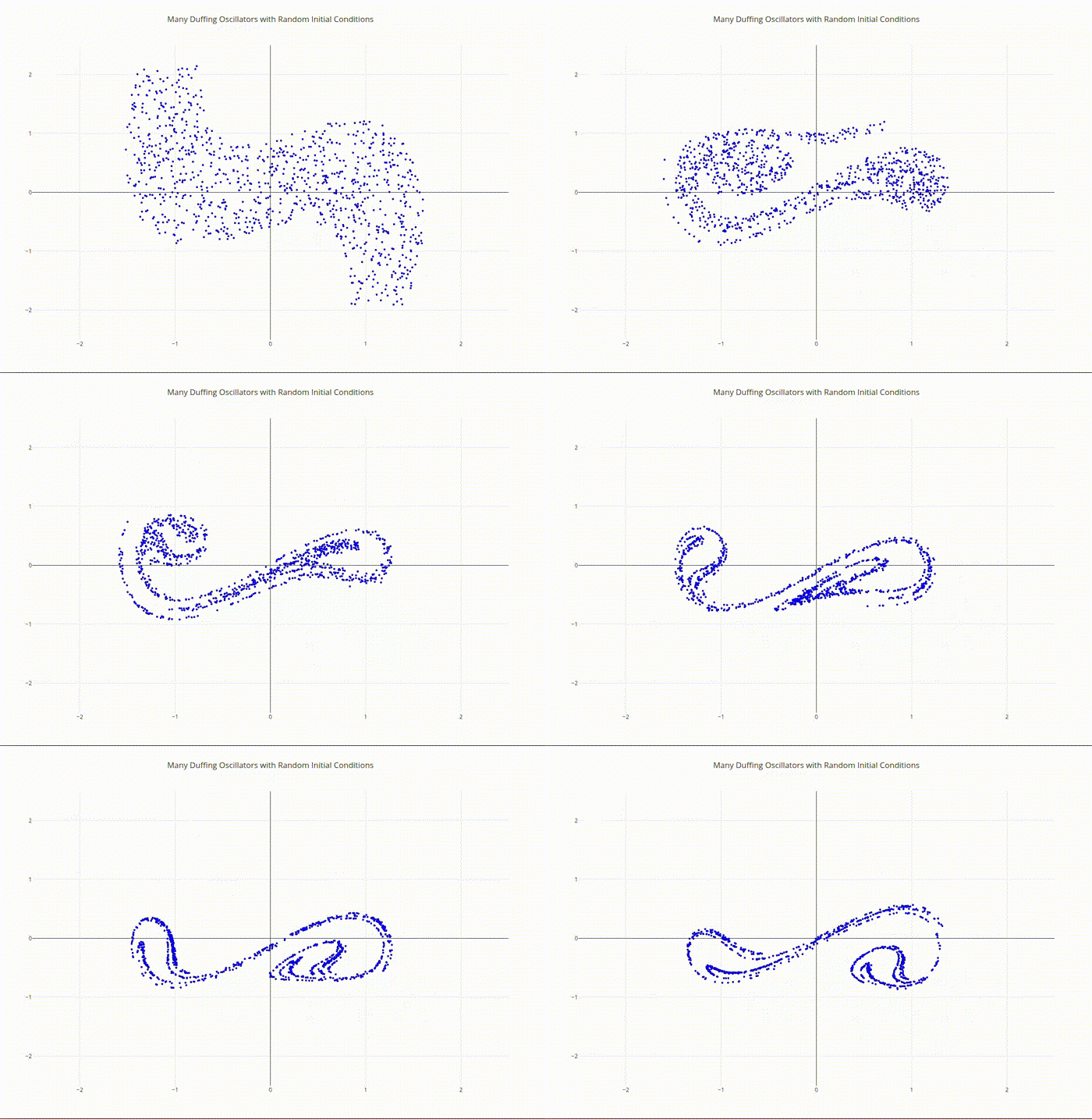
Duffing Oscillator Ensemble Phase Space Output
- See also
- plotly::Figure For the main plotting interface
- plotly::Figure::update() For real-time phase space updates
#include "plotly/plotly.hpp"
#include <chrono>
#include <cmath>
#include <random>
#include <thread>
#include <utility>
#include <vector>
// Duffing equation parameters
const double delta = 0.2;
const double alpha = -1;
const double beta = 1;
const double gamma = 0.3;
const double omega = 1.2;
const int n = 1000; // Number of oscillators
const double dt = 0.01;
double t = 0;
// Random number generation
std::random_device rd;
std::mt19937 gen(rd());
std::uniform_real_distribution<double> posDist(-2.0, 2.0);
std::uniform_real_distribution<double> velDist(-1.0, 1.0);
// Random initial positions in [-2, 2] and velocities in [-1, 1]
std::vector<double> xList(n);
std::vector<double> vList(n);
for (int i = 0; i < n; i++) {
xList[i] = posDist(gen);
vList[i] = velDist(gen);
}
// Duffing ODE derivatives
auto f = [delta, alpha, beta, gamma,
omega](double x, double v, double t) -> std::pair<double, double> {
return {v, (-delta * v) - (alpha * x) - (beta * std::pow(x, 3)) +
(gamma * std::cos(omega * t))};
};
// 4th-order Runge-Kutta integration step
auto rk4Step = [&f](double x, double v, double t,
double dt) -> std::pair<double, double> {
auto [dx1, dv1] = f(x, v, t);
auto [dx2, dv2] = f(x + (dx1 * dt / 2), v + (dv1 * dt / 2), t + (dt / 2));
auto [dx3, dv3] = f(x + (dx2 * dt / 2), v + (dv2 * dt / 2), t + (dt / 2));
auto [dx4, dv4] = f(x + (dx3 * dt), v + (dv3 * dt), t + dt);
double xNew = x + (dt / 6 * (dx1 + 2 * dx2 + 2 * dx3 + dx4));
double vNew = v + (dt / 6 * (dv1 + 2 * dv2 + 2 * dv3 + dv4));
return {xNew, vNew};
};
// Create a plotly figure
plotly::Figure fig;
fig.openBrowser();
// Initial phase space plot
fig.newPlot(
{{{"x", xList},
{"y", vList},
{"mode", "markers"},
{"type", "scatter"},
{"marker", {{"size", 4}, {"color", "blue"}, {"showscale", false}}}}},
{{"title",
{{"text", "Many Duffing Oscillators with Random Initial Conditions"}}},
{"xaxis", {{"title", "x"}, {"range", {-2.5, 2.5}}}},
{"yaxis", {{"title", "v"}, {"range", {-2.5, 2.5}}}},
{"showlegend", false}});
// Time evolution and update
// Simulate 5 steps to speed up
for (int step = 0; step < 5; step++) {
for (int i = 0; i < n; i++) {
auto [x_new, v_new] = rk4Step(xList[i], vList[i], t, dt);
xList[i] = x_new;
vList[i] = v_new;
}
t += dt;
}
// Update the plot
// Sleep for 30 milliseconds (like the JavaScript setInterval)
std::this_thread::sleep_for(std::chrono::milliseconds(30));
}
return 0;
}
auto isOpen() const -> bool
Check whether the figure is currently open.
Definition plotly.cpp:404
auto update(const Object &traceUpdate, const Object &layoutUpdate=Object()) -> bool
Update an existing plot.
Definition plotly.cpp:417
auto newPlot(const Object &data, const Object &layout=Object(), const Object &config=Object()) -> bool
Create and render a new plot.
Definition plotly.cpp:408
auto openBrowser(bool headless=false) -> bool
Open the figure in the browser.
Definition plotly.cpp:529
Public Plotly C++ API header.